
So the play has been chosen, a cast auditioned and selected, a director appointed, dates inked into the diary, preparations made regarding scenery, set dressing, lighting … but wait! Those bits are (relatively) straightforward, there’s now something else to consider …
Something that is wearisome to many actors, terrifying to some, drives others to tears … something that can even seem like a stomach churning, mind numbing trudge over a huge and impassable mountain range!
Have you guessed what I’m talking about ? Well, it’s the fact that every performer on stage must study the script and learn their … LINES!
Blocking (where and how actors move during the play), character motivation, any unusual speech requirements, such as accents, and so on are important elements to consider as soon as rehearsals begin, but it’s lines, lines and more lines that actors have to “bash” into their heads. Not literally – “bash” is often used by actors as shorthand for learning lines!
A perennial problem
Recently, I was privileged to see a fabulous performance of the now legendary comedy play Noises Off by Michael Frayn at Blackpool Grand Theatre.
The play satirises a small travelling professional company, touring provincial venues with a tired, misfiring 1970s bedroom farce titled Nothing On! It’s a hilarious, breathless, and clever piece of theatre that highlights every conceivable failing of the company.
The show speeds up as mistakes multiply and almost literally falls to pieces as it moves along. One character highlights the line learning problems that often afflict actors. In the opening scene, housekeeper Mrs Duckett (Dotty) fluffs her lines in rehearsal again and again to the increasing anger of foul mouthed Director (Lloyd):
Dotty: How about the words, love? Am I getting some of them right?
Lloyd: Some of them have a very familiar ring to them …
Dotty: Only, it’s like a fruit machine in there!
Lloyd: I know that Dotty.
Dotty: I open my mouth and I don’t know what’s going to come out, three oranges or two lemons and a banana!
This got me thinking about what is a perennial problem for both amateur and professional actors. Accurately recalling and reciting lines as written in a stage script, might not seem a problem to audiences enjoying a night out.
But it is a problem. Often a big problem.
When rehearsals start, actors should ideally already know their lines in full. In amateur theatre this often does not happen, meaning that some of the cast have their head in the script rather than actually acting a scene. This is stressful to line learners; stress makes it harder to properly learn lines, and so often the lines don’t “stick”.
What’s more, achieving the personal minimum of recalling your own lines is not enough. Performers also need to know the other actors’ lines, pauses, and stage moves so they can also know when, where and how to deliver their own carefully remembered lines.
Approaching the challenge
So, how do actors prepare to learn their lines? Personally, I usually do a rough word count of how many lines my character has before I begin studying a script, although fellow performers often find this a bit much.
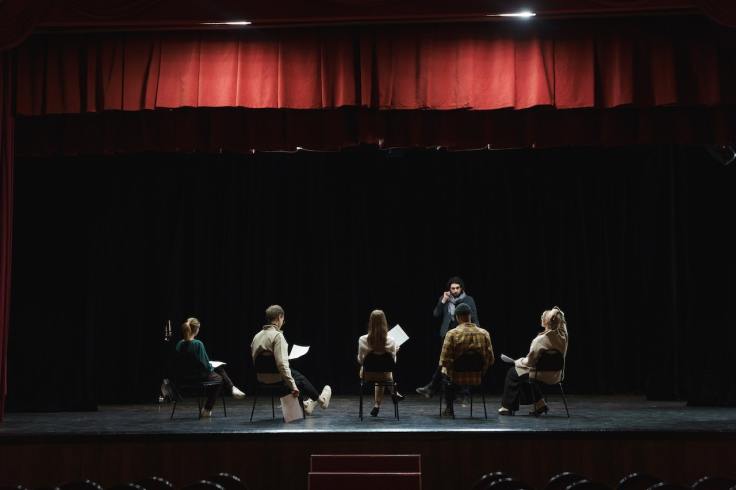
Feel free to laugh at my methods, but this gives me a really good idea of how much time I will realistically need to learn most of my lines. I find I can thoroughly learn and remember about 6 to 8 lines a day, more or less. Then, before rehearsals begin, I can calculate roughly how many days it will take me to learn most of my lines.
If you find line counting a bit OTT, you might like a Monty Python 1970s TV sketch in which John Cleese portrays an eccentric old actor called Sir Edward. In the sketch, he itemises all his great Shakespearean roles and exactly how many lines he had to remember for every character!
Sir Edward: “I don’t want you to get the impression that it’s just a question of the number of words … I mean getting them in the right order is just as important … old Peter Hall used to say to me “They’re all there Eddie, now we’ve got to get them in the right order!”
All this being said, in early rehearsals I usually have an approximate knowledge of my lines. Fortunately that’s normally okay, as everyone else seems to have adopted the same approach!
Practical methods
Then comes the regular commitment to learning lines as you approach performance night. Methods to hammer those pesky lines into your head can include:
- Covering up your lines with a piece of paper and lifting said paper up and down until they have been absorbed into the brain (my personal method of choice).
- Listening repeatedly to audio or video of the play.
- Recording just the other actors’ lines to your phone, and then playing it back and reciting your lines on cue without the script.
- Writing down your lines over and over again.
… the list goes on.
The actor’s lifeline
Nevertheless, if all else fails the prompt is always there to rescue things, well perhaps! Michael Green in his hilarious book, The Art of Coarse Acting, recalls during his own amateur and professional acting stints some less than helpful prompts, whose responses to terrified actors who missed or fluffed lines included “Wrong!” and “Still Wrong!”
Line learning really can be a pain, especially for amateur thesps that have lives, jobs, business dealings and caring commitments but it is at the heart of putting on a play, and part of the difficult gestation period of getting going, before stuff can really start happening on stage.
The sense of achievement when you do learn your lines and hearing yourself recite them confidently in front of an audience is immense.
If you are thinking of joining us at RADS, would like to act but feel a little bit concerned that learning lines might be too difficult – don’t be! RADS is a friendly and supportive society that will help you learn your lines and fulfil your ambition of getting on stage and acting in a play!
Neil
 Reformed Allerton Dramatic Society (RADS)
Leave a comment